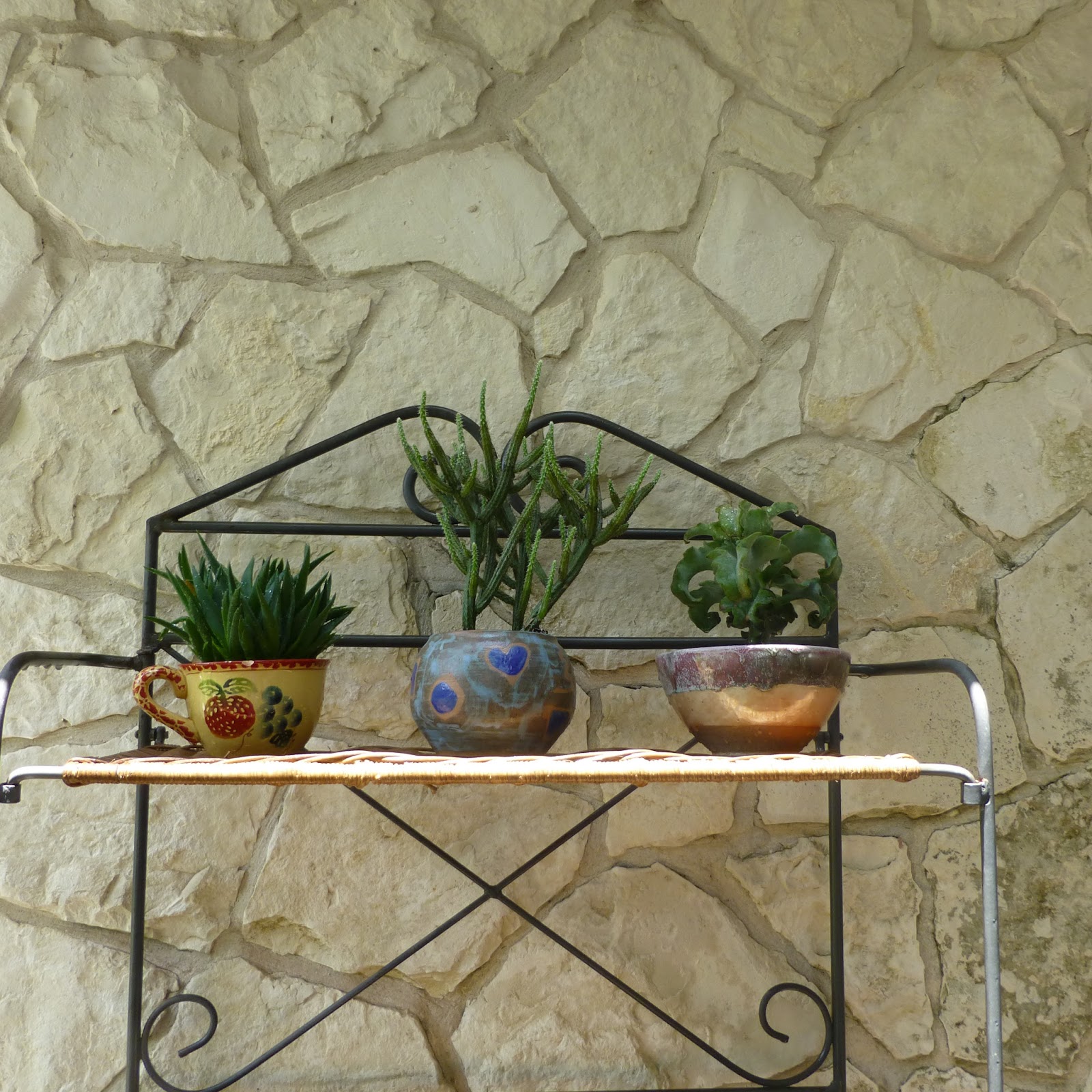
With a garden full of new landscaping/hardscaping and a bunch of
pottery seconds sitting in my house, I decided to take action and
enhance our new front patio.
Happily, on large trash
day, Avie found a discarded baker's rack, which we absconded with and
put up in front. Then I checked out my seconds, consisting of pieces I'd
made which had something I didn't like. I also took a trip to our local
Goodwill for a few extra pieces, to fill in the blanks. Then I tallied
up the sizes of our pottery pieces.
Finally, we
went over to our favorite garden shop and purchased a lot of succulents
to fit into these vessels. The result: NICE!!!!
As time goes on, I'll see how these cuties do. I'll probably add to the collection as I accumulate more pottery seconds, or find some in the wild.
What do you do with YOUR seconds?
Showing posts with label mugs. Show all posts
Friday, July 12, 2013
What to Do with Seconds
Labels:
agru,
agruarts,
april grunspan,
bowl,
ceramics,
clay,
cup,
cups,
etsy,
gardening,
mug,
mugs,
plate,
pottery,
succulent garden,
succulents,
teacup garden
Friday, October 26, 2012
Of Nature and Inspiration: Snowy Owl Project
Inspiration can come from many places. In this case, it came from a
PBS show in the Nature series. This particular one was about Snowy Owls
-- my favorite bird, and one we were privileged to see on a birding trip
to Amherst Island in Ontario, Canada one February, many years ago.
The Snowy Owl is one of the largest owls in the world. That, combined with their striking white feathers and incredibly golden yellow eyes.....well, you know!
So I've decided to make mugs, using those eyes and that coloring. I intend to keep the mug white and use yellow and black underglazes to paint in the eyes and beak. Then, if I feel it's appropriate, I'll add some light carving to accentuate the feathering around the beak.
My concept is that the owl will be recognizeable, even in the absence of more details. I might even play with the mug's shape, to reflect the roundness of the Owl's head, though I'll have to make sure it doesn't lose function with that inward curve.
With an injured finger, I probably won't be back on the wheel until November. But that's soon enough and I can't wait to work on this idea!
Sunday, October 30, 2011
My husband Avi and I are big coffee snobs. Morning coffee during the week involves the use of a Chemex coffee maker, a special filter, recently roasted beans which we grind ourselves, and water heated to exactly 195 degrees on an induction cooktop. All in all, the process takes about 20 minutes and yields an incredibly complex and smooth cup o' Joe.
The other day, our favorite high end coffee shop, Local, offered a workshop in a new brewing system called the Clever. After the workshop, we got into a discussion with the other attendees about what, in their opinion, constitutes a perfect coffee cup.
First, and most importantly, we agreed many coffee cups are too large to savor well-brewed coffee. We want our coffee to be hot, accessible, and in a mug which allows us to savor rather than gulp. The general consensus was anything over 12 ounces was just too big.
As coffee cools, its flavor changes. One morning, when you have some extra time to really taste your coffee, play with this. Brew it, pour it into your cup, and taste it at different temperatures as it cools. You should note a change, even with cheap coffee. Coffee connoisseurs want a cup that allows them to enjoy their coffee, while keeping it above 134 degrees for the time it takes to sip and savor.
It's also important to consider the ergonomics of your cup -- how does it feel in the hand and against the lips?
For me, this means a hand-pulled handle. After all, what feels better in the hand than something shaped in the hand? Also take into account the particular size of the hand holding the cup. How many fingers will fit in that handle? Will it feel too large for a small hand? Will it be too tight for a large hand? In the art of cups or mugs one size does not fit all, so vary your designs to take this into account.
Don't make handles too thin, since that makes everything else about your cup feel flimsy and unbalanced. Don't put any fancy textures on them, braid three skinny coils, or do anything to detract from simply holding a cup to sip a beverage. A cup is a functional object; function should be integral to design.
As for the rim, too thick and it feels like you're going to lose your liquid, too thin and it will be too sharp against the lips or be liable to chipping with hard use (and coffee cups get hard use). I use the web area between my first and middle fingers over my rim as the just-thrown piece turns on the wheel to "finish" my rims. I've found that technique creates a rim which feels right against my lips.
Shape? I put a "waist" on my mugs. Personally, I like sticking my hand through the handle and holding the mug itself. This particular shape gives me something to hold that feels good in my hand. I also like this shape because it helps keep the coffee warm for a longer period of time. (I also leave the bottom part of my mug a bit thicker, to add some insulation.)
Granted, the mug below is a bit larger than I would like -- but not everything I make is for the coffee snob. The coffee snob is simply the focus of this particular post.
Let's conclude by turning to Daniel Rhodes and his wonderful book Pottery Form:
"The cup is such a simple form . . . . Its functional aspects are few. The cup works best if the height and width are about the same. The emphasis may be either toward the upright or the horizontal, but if the cup is too high it will be unstable. On the other hand, if it is too broad and low, the contained liquid will slosh and splash. In broad cups, hot liquid will cool too fast. If there is no handle, a foot will make the cup easier to pick up and to hold. The rim touching the lips is smooth and may turn outward slightly, but not inward. This edge or rim, if too thick, will feel awkward at the lips. Inside, the cup is smooth, without ridges or sharp corners. The scale is determined by the amount that is comfortable to drink at one time."
Keep on throwing!
Sunday, March 01, 2009
I've been pondering the mantra of "etsy success" for quite a while now, combining it with what I see regarding all the rest of the advice out there -- good photos, marketing yourself, participating in forums, chats, blogs, twitter, etc., etc., etc., until you don't have a second left in the day to create your product.
I think people have it all backwards. You don't list a bunch of stuff and then go everywhere to market it. Sure, people will look. But the trick isn't getting people to look. Additionally, as much as we like the concept of "views", "hearts", and "favoriting", it ALL comes back to placement.
Before even beginning to create a product, take a good look around. What are people listing in shops that carry your genre?
So, let's talk about coffee mugs. OY! Right now there are 243 pages of cups listed in Ceramics and Pottery. A mug is a mug and a green glaze is a green glaze. There are only so many shapes a functional mug can take, so let's put that a aside for a moment as well. In the end, how should one approach a mug that might sell?
1. When I'm just perusing mugs, I usually stop at ones that are eye-catching. This one by gracesheese fits the bill. It's red, it's patterned, and it's photographed against a background that just makes it POP. So, using this parameter, be sure you're making something that will grab the eye against all the other mugs around yours. In this case, color, pattern and background.
2. The next one that jumps out at me is this one by stepanka. Even though it's photographed against a non-contrast background, it just draws the eye because of the surface decoration. Again, it's something different from the sea of mugs surrounding it.
shoshonasnow has this mug that also pulled my eye. This time it was the combination of the color and the shape that did it.
Beyond getting noticed in a general search for something like mugs, you might also want to think about specific "niche" searches you might be able to fill. After all, a mug is a mug is a mug (aplogies to Gertrude Stein). What type of mug can you make in anticipation of things people might search?
One approach would be to check out the holidays. There are all sorts of things that would make a mug a holiday gift: something with familial personalization ("Mother", "Sis", "Best teacher in the world"), for Valentine's day -- a message of love such as this beauty by RedGateCeramics.
Personally, I've decided to enter the Jewish niche market. This works well for me: I'm Jewish, I love giving handmade gifts for weddings, Bnai Mitzvot (Bar and Bat Mitzvahs), and baby showers. I've simply put my ideas on the etsy market and it's been working well for me.
My experience has shown me that a great many of my sales on etsy were not impulse purchases. They were from people coming to etsy with something specific in mind. In my case, it's often a cup for their Jewish mother or father, an end of the year gift for a Hebrew school teacher, that perfect wedding gift for a Jewish couple. I've created product and then tagged it accordingly, so my customers, who don't know they're mine yet, can find me through the search engine (and in spite of rumors to the contrary, that search engine on etsy is still working).
You could just as easily take your products and think about potential searches you can fulfill. How about birdwatchers? Office workers who need a mug at their desk? Kids going off to college and want their mug to set them apart from the rest of the coffee drinkers in their dorm? Dog owners. New mothers and fathers. Outdoorsy people. Couch potatoes. They're all out there and, I'll bet, most of them use mugs. Why not make yours the one they crave????
In short? Etsy product success isn't always in the marketing -- though that's an essential part of getting yourself out there.
Friday, February 20, 2009
Sunday, February 01, 2009


Sgraffito
No, it's not something you spray on the sides of buildings or subway cars. It's a pottery technique. Basically, I took greenware (dried, but not fired clay), crushed it into a powder, added water and black mason stain (though you can add many different colors), and blended well.
Then I used this as a coating on the outside of leather hard pieces, after which I carved through to reveal the contrasting white clay beneath. Fire, glaze clear or with a transluscent color, and glaze fire. Voila!
In my case, I've been carving Hebrew "Mom" and "Dad". But last week I tried something different and took a couple of sketches from my friend David (see previous post), reduced them in size, and traced them onto the slip using a wood stick over a copy of his drawing. Then I carved through the indented lines.
The final results make me smile -- cuz David is such a wonderful doodler. Looking forward to more sgraffito soon!
Sunday, January 18, 2009
It's been a great week in the studio with sgraffito (carving through colored liquid clay to reveal the lighter clay beneath) galore.
In addition to aba (father), ima (mother), saba (grandpa) and savta (grandma) mugs, I took some of David's animal sketches, along with a stencil, and made three whimsical mugs. There was one I love so much it might well wind up in my cabinet for coffee, rather than in the etsy shop.
Of course, with sgraffito, the great consideration is glazing. Which glaze will show the carving, without being boring. I've been leaning toward clear glaze on the outside, with brighter colors lining the interior of the mug. As someone who's always loved contrast: color/black and white, matte/gloss, etc., this is a compatible voice for my designs. However, I'm in love with a lovely transparent cone 6 glaze called oribe (quite different from the cone 10 version). So I glazed a couple of the mugs with it.
They're out of the kiln. But I haven't had a chance to go over to the studio to see them, since someone else unloaded this firing. Tuesday is going to be fun!
Subscribe to:
Posts (Atom)


